Why Quality Lockout’s Non-Proprietary LOTO Procedures Are the Superior Choice for Industrial Safety
The Importance of Accessible Lockout/Tagout Procedures
Lockout/Tagout (LOTO) procedures are among the most critical safety documents within any industrial facility. They provide workers with the specific steps necessary to isolate hazardous energy before maintenance or servicing activities begin. OSHA’s Hazardous Energy Control Standard (29 CFR 1910.147) requires employers to establish and maintain procedures that protect employees from unexpected equipment startup and the release of stored energy.
As facilities modernize their safety programs, many vendors promote proprietary software platforms as the preferred method for managing LOTO procedures. While these systems may claim convenience, they often introduce long-term costs, operational limitations, and vendor dependency. Non-proprietary procedures delivered in editable Excel and PDF formats provide a more sustainable, flexible, and cost-effective solution for organizations seeking long-term control of their safety documentation.
Why Ownership Matters
A LOTO procedure is not software; it is a safety document. Like engineering drawings, standard operating procedures, and maintenance instructions, it should remain under the direct control of the organization responsible for implementing it.
When procedures are delivered in editable Excel and PDF formats, the client owns the files and can revise, distribute, archive, and manage them without relying on a third-party software vendor. This ownership ensures that critical safety information remains accessible regardless of changes in software licensing, vendor support, or technology platforms.
Proprietary systems often place an organization’s safety data inside a closed environment controlled by the software provider. As a result, access to information may become dependent on active licenses, vendor support agreements, or platform-specific requirements.
Eliminating the Risks of Vendor Lock-In
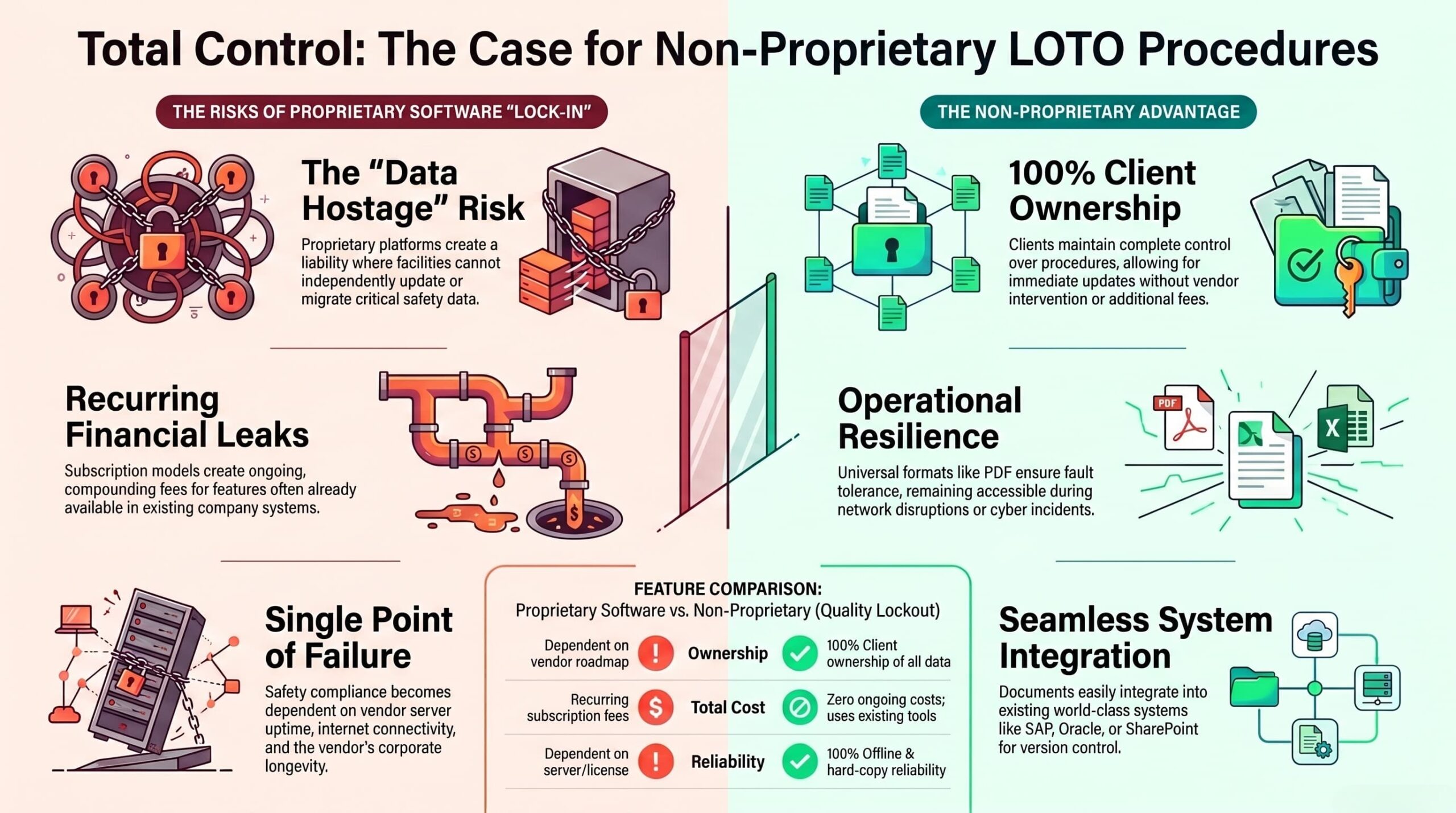
One of the most significant disadvantages of proprietary software is vendor lock-in. Once a facility’s procedures are embedded within a proprietary platform, moving those procedures to another system can become difficult, expensive, and time-consuming.
Vendor lock-in can create several challenges:
- Ongoing subscription and licensing costs.
- Dependence on the vendor for software updates and support.
- Potential limitations on exporting or migrating data.
- Reduced flexibility when modifying procedures.
- Increased costs associated with system changes or upgrades.
By contrast, non-proprietary Excel and PDF procedures remain fully accessible and editable without specialized software or vendor involvement.
Leveraging Existing Enterprise Systems
Many industrial organizations already maintain sophisticated document management systems capable of managing LOTO procedures effectively. In many cases, purchasing separate proprietary LOTO software duplicates capabilities that already exist within the organization.
Common enterprise document management platforms include:
- SAP Document Management System (DMS)
- SAP Extended Enterprise Content Management
- Oracle WebCenter Content
- Microsoft SharePoint
- OpenText Documentum
- IBM FileNet
- OnBase by Hyland
- M-Files
These systems typically provide the same core document-control functions that proprietary LOTO software vendors promote, including:
- Version control
- Revision history
- Approval workflows
- User permissions
- Audit trails
- Search functionality
- Records retention
- Enterprise-wide document distribution
For organizations already utilizing SAP, Oracle, SharePoint, or similar platforms, integrating Quality Lockout’s non-proprietary LOTO procedures into existing infrastructure often results in lower costs and improved administrative efficiency.
Operational Resilience During Emergencies
Safety-critical information must remain available when workers need it most. During maintenance outages, network disruptions, cyber incidents, or emergency situations, employees cannot afford delays in accessing energy isolation procedures.
Quality Lockout’s non-proprietary Excel and PDF procedures can be stored in multiple locations, distributed electronically, printed for field use, and accessed offline. This flexibility helps ensure that procedures remain available even when network connectivity or software systems are unavailable.
Proprietary software platforms may depend on servers, authentication systems, internet connectivity, or active licensing services. While these systems can be effective under normal operating conditions, they introduce additional points of failure that can affect access to critical safety information.
A robust safety program should prioritize accessibility and redundancy rather than relying on a single software platform.
Long-Term Sustainability and Future-Proofing
Industrial facilities often operate for decades, and their safety documentation must remain usable throughout the life of the facility.
Excel and PDF formats have become universal standards for business and technical documentation. They can be opened, archived, and shared using a wide variety of software applications, making them highly resilient to technological change.
Proprietary software solutions, however, depend on the continued availability and support of a specific vendor. If the platform is discontinued, acquired, or significantly modified, organizations may face costly migration projects to preserve access to historical safety records.
Choosing non-proprietary formats helps future-proof a facility’s hazardous energy control program while maintaining long-term accessibility.
Cost Savings Without Sacrificing Compliance
Organizations often assume that proprietary software is necessary to maintain compliance and document control. In reality, compliance is achieved through the quality, accuracy, accessibility, and maintenance of procedures—not through the software used to store them.
By leveraging existing document management systems and utilizing Quality Lockout’s non-proprietary and fully editable Excel and PDF procedures, organizations can reduce software expenses while maintaining robust document control processes. This approach allows facilities to invest resources where they matter most: employee safety, procedure accuracy, training, and continuous improvement.
Conclusion
Lockout/Tagout procedures are among the most important safety documents within an industrial facility. They should remain accessible, editable, and under the direct control of the organization responsible for protecting its workforce.
Quality Lockout’s non-proprietary LOTO procedures delivered in Excel and PDF formats provide complete ownership, lower long-term costs, improved operational resilience, and seamless integration with existing enterprise systems. They eliminate vendor lock-in, support emergency preparedness, and ensure long-term accessibility of critical safety information.
For organizations focused on safety, compliance, sustainability, and operational independence, non-proprietary LOTO procedures represent the most practical and future-ready approach to hazardous energy control.
For more information, visit www.qualitylockout.com.
About the Author
Jared Lowery has over 24 years of experience in the LOTO industry and is a subject matter expert at Quality Lockout, LLC, where he leads the development, implementation, and continuous improvement of Lockout/Tagout (LOTO) programs across diverse industrial environments. With extensive experience in hazardous energy control, regulatory compliance, and operational safety, Jared supports the team that specializes in helping organizations build machine-specific LOTO procedures that meet OSHA 1910.147 requirements and withstand real-world operational demands. His work focuses on reducing risk, improving program accuracy, and elevating safety performance through clear documentation, field-ready procedures, and practical compliance strategies.
If your organization is unsure whether its LOTO procedures meet OSHA’s intent — or if you’re relying on proprietary documentation — now is the time to take action.
Quality Lockout, LLC provides machine-specificnon-proprietary procedure development, program audits, and turnkey LOTO solutions designed to eliminate compliance gaps and protect your workforce.
To strengthen your LOTO program or schedule a consultation, connect with the Quality Lockout team at Quality Lockout, LLC and ensure your procedures are accurate, compliant, and built for real-world use. Reach us at qualitylockout.com or call 1.800.343.0829.