Confined Spaces – Control vs. Elimination
When it comes to workplace safety, one of the most common misconceptions is believing that controlling a hazard is the same as eliminating it. While both approaches reduce risk, they are fundamentally different under OSHA regulations—and understanding the distinction can prevent injuries, improve compliance, and strengthen your organization’s safety culture.
What Is Hazard Control?
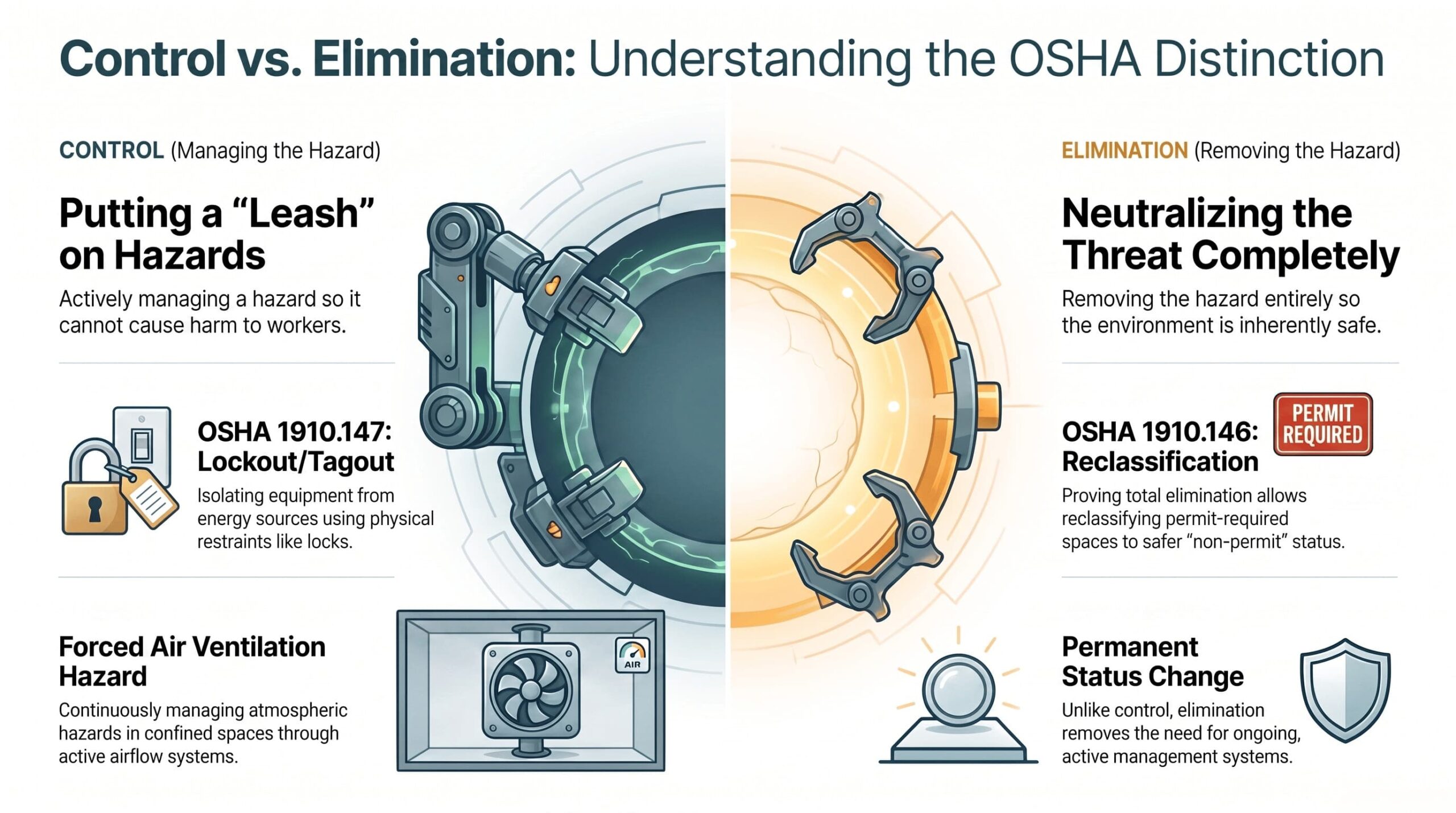
Hazard control means the hazard still exists, but measures are in place to prevent employees from being exposed to it.
A great example is Lockout/Tagout (LOTO) under OSHA 1910.147. During equipment maintenance, energy sources are isolated using locks and devices to prevent unexpected startup. Although the equipment cannot be operated, the electrical, hydraulic, pneumatic, or mechanical energy still exists. If the lockout isolation fails or is bypassed, the hazard immediately returns.
The same principle applies to forced-air ventilation in Permit-Required Confined Spaces (PRCS) under OSHA 1910.146. Ventilation improves air quality, but only while the system is operating. If the ventilation stops, the atmospheric hazard can quickly return.
What Is Hazard Elimination?
Hazard elimination removes the danger entirely rather than managing it.
OSHA recognizes elimination as the preferred method of hazard reduction because it creates an inherently safer workplace. Under OSHA 1910.146, a permit-required confined space may be reclassified as a non-permit space only after every hazard has been permanently eliminated—not simply controlled.
Unlike temporary safeguards, elimination does not rely on continuous equipment operation.
Why the Difference Matters
Confusing control with elimination can have serious consequences.
Organizations that assume a controlled hazard has been eliminated may unintentionally violate OSHA requirements, increase liability, or expose employees to unnecessary risk. For example, relying on continuous ventilation does not qualify a confined space for permanent reclassification because the hazard has not actually been removed.
Understanding this distinction helps safety professionals make informed decisions about risk assessments, confined space programs, and energy isolation procedures (LOTO).
The Goal of Every Safety Program
Control measures such as Lockout/Tagout, ventilation, monitoring, and administrative procedures are essential for protecting workers during maintenance and operations. However, whenever possible, organizations should strive to eliminate hazards through engineering and design improvements.
Elimination reduces long-term risk, lowers administrative burdens, and creates a safer work environment for everyone.
Final Thoughts
By understanding the difference between control and elimination, safety leaders can improve OSHA compliance, reduce operational risk, and build a stronger, more resilient safety culture.
Need help evaluating whether your confined spaces or energy isolation procedures meet OSHA requirements? Our safety professionals can help assess your program and identify opportunities to move from hazard control to true hazard elimination.
About the Author
Jared Lowery has over 24 years of experience in the LOTO industry and is a subject matter expert at Quality Lockout, LLC, where he leads the development, implementation, and continuous improvement of Lockout/Tagout (LOTO) programs across diverse industrial environments. With extensive experience in hazardous energy control, regulatory compliance, and operational safety, Jared supports the team that specializes in helping organizations build machine-specific LOTO procedures that meet OSHA 1910.147 requirements and withstand real-world operational demands. His work focuses on reducing risk, improving program accuracy, and elevating safety performance through clear documentation, field-ready procedures, and practical compliance strategies.
If your organization is unsure whether its LOTO procedures meet OSHA’s intent — or if you’re relying on generic or grouped documentation — now is the time to take action.
Quality Lockout, LLC provides machine-specific procedure development, program audits, and turnkey LOTO solutions designed to eliminate compliance gaps and protect your workforce.
To strengthen your LOTO program or schedule a consultation, connect with the Quality Lockout team at Quality Lockout, LLC and ensure your procedures are accurate, compliant, and built for real-world use. Reach us at qualitylockout.com or call 1.800.343.0829.