LOCKOUT / TAGOUT – Do both words mean the same thing?
In industrial safety, protecting workers from the unexpected release of hazardous energy is not just a best practice—it is a legal requirement. While often used interchangeably, Lockout and Tagout serve distinct roles in an effective Lockout/Tagout (LOTO) program. They are both designed to ensure equipment is kept deenergized while being serviced, but they have different tactics and requirements.
Although they have different tactics and requirements, they are both designed to ensure equipment is kept deenergized while being serviced.
What is the Difference Between Lockout and Tagout?
At its core, the difference lies in the level of physical protection provided:
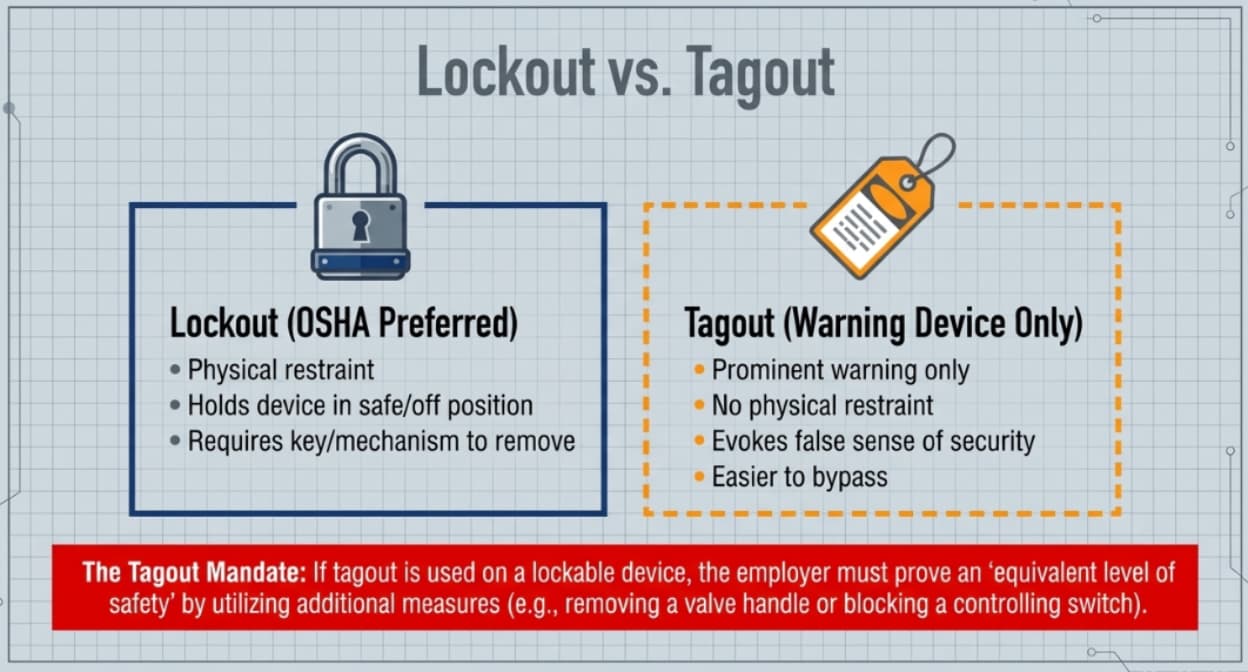
- Lockout: A physical method of isolation. A lockout device (such as a padlock) is used to hold an energy-isolating device in a safe position, preventing the equipment from being energized.
- Tagout: A prominent warning system. A tag is securely fastened to an energy-isolating device to indicate that the equipment must not be operated until the tag is removed.
Comparison Table: Lockout vs. Tagout
| Feature | Lockout | Tagout |
| Primary Function | Physical Prevention | Visual Warning |
| Security Level | High (Requires a key/combination) | Moderate (Easily bypassed if ignored) |
| OSHA Preference | Preferred method when possible | Used only if lockout is not feasible |
| Required Hardware | Padlocks, chains, or blocks | Durable, standardized tags |
Lockout Use Cases
Lockout is what is commonly used in in most industries. Placing your personal lock on an energy source correctly is the best way to prevent it from accidentally being turned on. This involves having an accurate lockout procedure and a good training program. OSHA requires every authorized employee to be issued with locks, and these locks shall indicate the identity of the employee applying the device. This is done by one of the following.
- Firmly attaching a durable ID badge with your name to the lock.
- Applying a sticker with your name to the lock.
- Engraving your name into the lock.
- Utilizing a log to identify the person using a lock with a particular serial number or similar identifier.
Tagout Use Cases
Tagout is used in conditions when an energy source cannot be locked out, such as older equipment that may not have lockable isolation points or massive jobs where the number of locks would be impractical. Tagout relies upon training and communicating information to employees. With a tag, additional elements are necessary to provide the equivalent safety of a lockout. Training is essential, so no one can activate the energy sources that are tagged out.
A word of caution – Tagout is not as safe as lockout, Tags may evoke a false sense of security. Their use and meaning needs to be understood as part of the overall energy control program.
Can you use Tagout instead of Lockout?
OSHA generally requires the use of lockout devices unless the employer can demonstrate that a tagout system provides “full employee protection” equivalent to a lockout. If a piece of machinery is “capable of being locked out,” it must be locked out.
Critical Safety Requirements
-
Durability: Devices must withstand the environment (heat, chemicals, moisture).
-
Standardization: LOTO hardware should be uniform in color, shape, or size within a facility.
-
Individuality: Each lock must be unique; only the employee who applied the lock should have the key to remove it.
Creating Your Policy
If you are only using lockout, it is not necessary to include affixing a tag to the lockout point. This eliminates an unnecessary step (and material cost) due to not having to constantly replenish the tags.
One good option is to have locks of the same brand, with different colors to denote different departments or groups.
- Ensure they have stickers or a photo ID badge issued to each authorized employee to be used with the locks.
- They should have the employee’s name legibly written and say something to the effect of “Locked-out”, “ Do not remove”, etc.
Eliminating tags from your policy when not used for tagout is an easy way to remove confusion, cut costs and help with compliance.
Do You Still Have Questions? Quality Lockout LLC Is Here to Help
At Quality Lockout LLC, we understand how challenging it can be to keep LOTO programs updated — especially when equipment changes, teams are stretched thin, and documentation piles up. That’s why we offer a procedure creation and comprehensive annual inspection service designed to make compliance simple, accurate, and stress-free.
Our goal is to make your LOTO program something you can trust — not something you worry about. We work alongside your team to solve issues, close gaps, and build a safer, more compliant workplace.
Keeping you compliant isn’t just our job — it’s our commitment.
Here’s a quick visual for reference recapping the difference between Lockout & Tagout.
About the Author
Phillip Lowery brings more than 30 years of OSHA compliance experience and a strong maintenance background to his work at Quality Lockout LLC. As a subject matter expert in Lockout/Tagout, Phillip leads the development, implementation, and continuous improvement of LOTO programs across a wide range of industrial environments.
His expertise includes hazardous energy control, regulatory compliance, training, and machine-specific procedure development. Phillip and the Quality Lockout team specialize in building LOTO programs that not only meet OSHA 1910.147 requirements but also function effectively in real-world operations.
If your organization is unsure whether its LOTO procedures meet OSHA’s intent — or if you’re relying on generic or outdated documentation — now is the perfect time to act.
Quality Lockout LLC provides machine-specific procedure development, program audits, and turnkey LOTO solutions designed to eliminate compliance gaps and protect your workforce.