LOTO Guidance for Safer Operations – Robotic Cells
Lockout/Tagout (LOTO) remains one of the most effective safeguards we have against employee injuries — but sometimes specific situations encountered by teams aren’t always straightforward. Entering robotic cells is a prime example of one of these real-world challenges that must be addressed clearly in your company’s LOTO policy.
The goal is simple: protect people while keeping operations running smoothly. When employees understand how to navigate these scenarios, safety becomes second nature — not an obstacle.
A Practical Look at a Robotic Cell LOTO Scenario
Robotic Cells: Balancing Productivity and Safety
As automation becomes more common, robotic cells are now a standard part of modern manufacturing. While robots improve efficiency, they also introduce unique risks — especially during non-routine tasks like programming, troubleshooting, and maintenance.
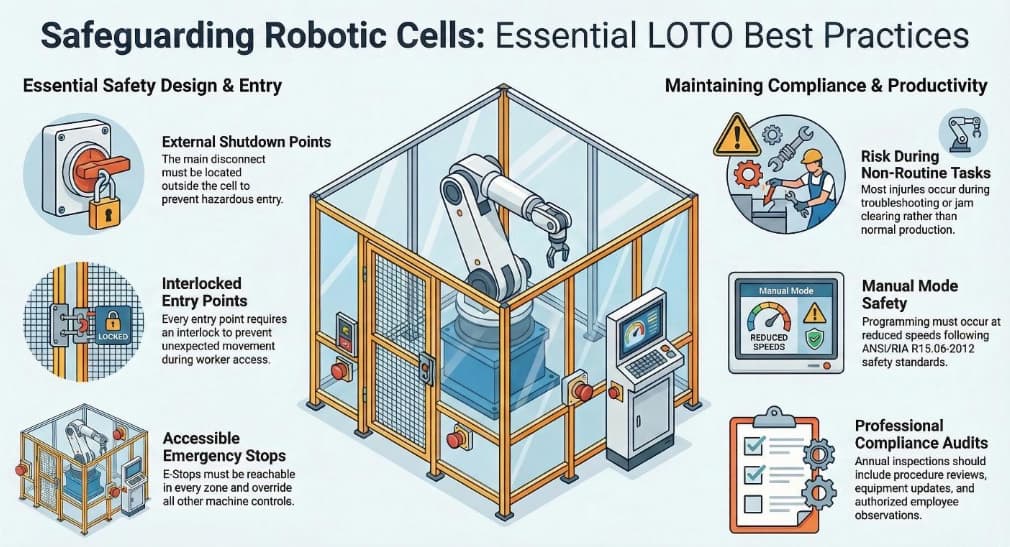
Most serious injuries don’t occur during normal production. They happen when someone enters the cell to fix a problem, adjust a program, or clear a jam. That’s why thoughtful design and clear procedures are essential.
Key Considerations for Robotic Cell Safety
Design matters.
A well-designed cell allows employees to perform preventive maintenance without defeating safeguards. When access is difficult, people find shortcuts — often without realizing the risk.
The main shutdown point must be outside the cell.
This is one of the most common issues we see nationwide. If the main disconnect is inside the cell, employees must enter a hazardous area just to begin the lockout.
Emergency stops must be accessible and override all other controls.
Every zone should have clearly marked, easy-to-reach E-stops.
Every entry point needs an interlock.
Interlocks prevent unexpected movement and protect employees entering the cell.
Programming requires special attention.
During programming, robots operate in manual mode at reduced speeds. Even at slow speeds, hazards exist. SOPs and risk assessments should reflect ANSI/RIA R15.06-2012 requirements.
Power is sometimes necessary — but exposure is not.
Many troubleshooting tasks require power. The key is ensuring employees are never in harm’s way while energized work is being performed.
A strong robotic cell program blends engineering controls, thoughtful design, and well-trained employees who understand when a full lockout is required.
How Quality Lockout LLC Can Support You
At Quality Lockout LLC, we understand how challenging it can be to keep LOTO programs updated — especially when equipment changes, teams are stretched thin, and documentation piles up. That’s why we offer a comprehensive annual inspection service designed to make compliance simple, accurate, and stress-free.
When we partner with you, you can expect:
- A full review of all your machine-specific procedures
- Updates to reflect equipment changes, layout adjustments, or new energy sources
- Documentation that meets OSHA’s certification requirements
- Authorized employee observations and sign-offs
- The option to complete annual LOTO training during the same visit
- Practical recommendations to strengthen your program and reduce risk
Our goal is to make your LOTO program something you can trust — not something you worry about. We work alongside your team to solve issues, close gaps, and build a safer, more compliant workplace.
Keeping you compliant isn’t just our job — it’s our commitment.
About the Author
Jared Lowery has over 24 years of experience in the LOTO industry and is a subject matter expert at Quality Lockout, LLC, where he leads the development, implementation, and continuous improvement of Lockout/Tagout (LOTO) programs across diverse industrial environments. With extensive experience in hazardous energy control, regulatory compliance, and operational safety, Jared supports the team that specializes in helping organizations build machine-specific LOTO procedures that meet OSHA 1910.147 requirements and withstand real-world operational demands. His work focuses on reducing risk, improving program accuracy, and elevating safety performance through clear documentation, field-ready procedures, and practical compliance strategies.
If your organization is unsure whether its LOTO procedures meet OSHA’s intent — or if you’re relying on generic or grouped documentation — now is the time to take action.
Quality Lockout, LLC provides machine-specific procedure development, program audits, and turnkey LOTO solutions designed to eliminate compliance gaps and protect your workforce.
To strengthen your LOTO program or schedule a consultation, connect with the Quality Lockout team at Quality Lockout, LLC and ensure your procedures are accurate, compliant, and built for real-world use. Reach us at qualitylockout.com or call 1.800.343.0829.