The LOTO Loophole Trap
5 Dangerous Misconceptions That Could Void Your Safety Compliance
Does your company pass the test?
In high-pressure industrial environments, uptime is everything. When a machine jams or a quick adjustment is needed, the temptation to “skip the full Lockout/Tagout process just this once” can feel justified.
But that mindset is exactly where organizations expose themselves to the greatest risk.
Under OSHA 1910.147, Lockout/Tagout (LOTO) is not a paperwork exercise—it’s a life-saving system. And more importantly, the so-called “exceptions” many teams rely on are far narrower—and more dangerous—than they appear.
If your safety program is built around perceived loopholes instead of machine-specific certainty, you’re operating one step away from a serious incident.
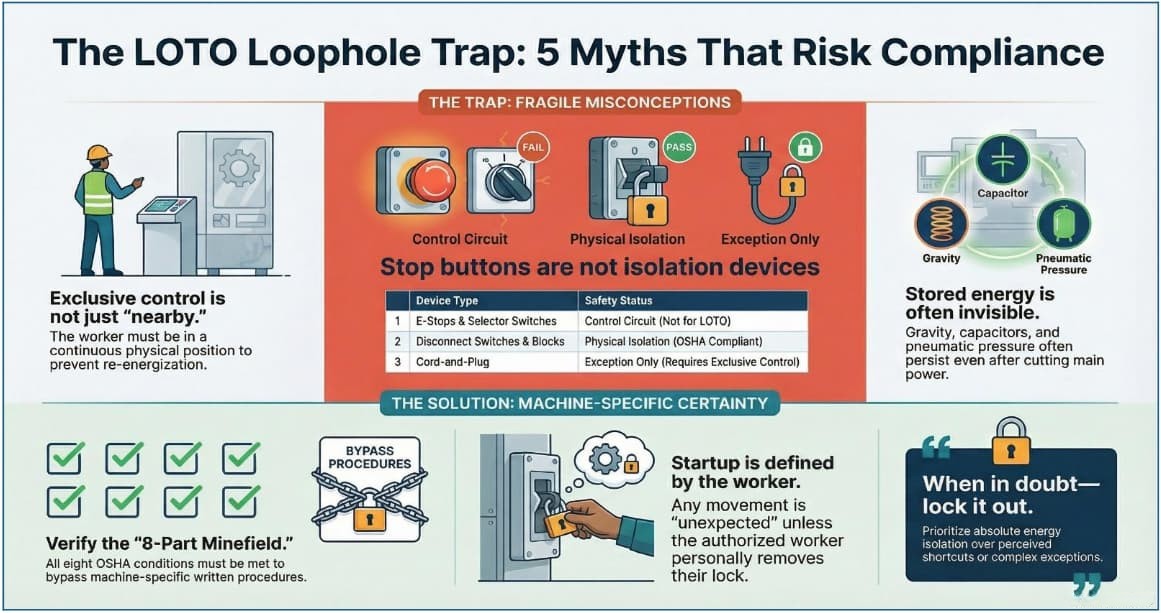
Below are the five critical realities that could quietly invalidate your compliance.
(1) The “Exclusive Control” Clock Is Always Ticking
The cord-and-plug exception is often misunderstood as a free pass. In reality, it’s one of the most fragile allowances in the entire standard.
To qualify, three conditions must be met:
- The equipment is powered only by a plug
- Unplugging removes all hazardous energy
- The plug remains under exclusive control of the worker
That last condition is where most programs fail.
“Exclusive control” doesn’t mean “nearby.” It means the authorized employee is in a continuous physical position to prevent re-energization.
👉 The moment they walk away—even briefly—the exception is gone.
Add a secondary energy source (battery, capacitor, pneumatic pressure), and the exception disappears instantly.
(2) The Hidden Energy Sources You Are Ignoring
Cutting power is not the same as eliminating hazardous energy.
Many machines still contain dangerous stored energy after shutdown, including:
- Capacitors holding electrical charge
- Gravity hazards (elevated components that can fall)
- Hydraulic or pneumatic pressure
- Residual motion from rotating parts
These are not edge cases—they are common conditions.
From a safety standpoint, potential energy is often the most dangerous energy, because it’s invisible and frequently overlooked.
If your procedure doesn’t explicitly address energy dissipation, your control is incomplete.
(3) The “Paperwork Reprieve” Is an 8-Part Minefield
There is a provision in OSHA 1910.147 that allows employers to skip writing a machine-specific procedure.
But this is often misunderstood.
You are not exempt from lockout—you are only exempt from documentation.
And only if you meet all eight conditions, including:
- No stored or residual energy
- A single energy source
- Complete de-energization through one isolation point
- Continuous lockout during servicing
- Exclusive control by one employee
- No risk to other workers
- No history of related incidents
Miss just one condition, and a written procedure is required.
In practice, very few machines qualify.
(4) Your “Stop” Button Is Not a Safety Device
This is one of the most dangerous misconceptions in industrial safety.
👉 Push buttons, selector switches, and PLC controls are not energy isolating devices. They are control circuits and they can fail.
Common failure modes include:
- Welded electrical contacts
- PLC programming or hardware faults
- Manual overrides at motor starters
- Environmental contamination (dust, moisture, debris)
True lockout requires physical isolation of the energy source, not just interruption of the control signal.
If you’re relying on a stop button, you’re relying on something that can—and eventually will—fail.
(5) “Unexpected” Is Defined by the Worker—Not the Machine
Some organizations assume that alarms, lights, or warning signals eliminate “unexpected startup.”
They don’t.
From OSHA’s perspective, “unexpected” is defined by the authorized employee performing the work.
If that employee did not remove their lock and authorize startup, any movement is considered unexpected—regardless of warnings.
Warning systems don’t eliminate risk—they shift responsibility onto the worker’s reaction time.
That’s not a safety strategy. It’s a liability.
The Real Risk: Operating in the Gray Area
The most dangerous place in any safety program is not non-compliance—it’s false confidence.
- Thinking an exception applies when it doesn’t
- Believing a control is sufficient when it isn’t
- Assuming a shortcut is acceptable “just this once”
This is how serious incidents happen.
The Strategic Imperative: Build a Culture of Certainty
The most effective safety programs follow a simple principle:
“When in doubt—lock it out and write it down.”
Moving away from exceptions and toward machine-specific certainty provides:
- Stronger employee protection
- Clear operational consistency
- Defensible compliance during audits or incidents
Final Thought
LOTO failures don’t usually come from ignorance—they come from misinterpretation.
The organizations at highest risk are often the ones that believe they are compliant.
So, the real question is:
Is your program built on certainty or are you operating in the fragile gaps of an exception?
When we partner with you, you can expect:
- A full review of all your machine-specific procedures
- Updates to reflect equipment changes, layout adjustments, or new energy sources
- Documentation that meets OSHA’s certification requirements
- Authorized employee observations and sign-offs
- The option to complete annual LOTO training during the same visit
- Practical recommendations to strengthen your program and reduce risk
Our goal is to make your LOTO program something you can trust — not something you worry about. We work alongside your team to solve issues, close gaps, and build a safer, more compliant workplace.
Keeping you compliant isn’t just our job — it’s our commitment.
About the Author
Jared Lowery has over 24 years of experience in the LOTO industry and is a subject matter expert at Quality Lockout, LLC, where he leads the development, implementation, and continuous improvement of Lockout/Tagout (LOTO) programs across diverse industrial environments. With extensive experience in hazardous energy control, regulatory compliance, and operational safety, Jared supports the team that specializes in helping organizations build machine-specific LOTO procedures that meet OSHA 1910.147 requirements and withstand real-world operational demands. His work focuses on reducing risk, improving program accuracy, and elevating safety performance through clear documentation, field-ready procedures, and practical compliance strategies.
If your organization is unsure whether its LOTO procedures meet OSHA’s intent — or if you’re relying on generic or grouped documentation — now is the time to take action.
Quality Lockout, LLC provides machine-specific procedure development, program audits, and turnkey LOTO solutions designed to eliminate compliance gaps and protect your workforce.
To strengthen your LOTO program or schedule a consultation, connect with the Quality Lockout team at Quality Lockout, LLC and ensure your procedures are accurate, compliant, and built for real-world use. Reach us at qualitylockout.com or call 1.800.343.0829.