
Lock It Out or Risk Everything:
Why LOTO Beats the “Minor Servicing” Gamble
Quick tasks—clearing a jam, checking alignment, tightening a component, or cleaning debris—are where serious injuries happen. Workers convince themselves they’re still in normal production. Supervisors feel pressure to keep lines moving. “If there is any doubt—lock it out.” — Jared Lowery, Quality Lockout, LLC.
Two Safety Systems — Two Very Different Purposes
Machine Guarding = Normal Production Machine guarding protects workers while equipment is energized and performing its intended manufacturing function. Examples include fixed guards, interlocked doors, and presence-sensing devices such as light curtains. These controls keep hands and bodies away from moving parts while production continues.
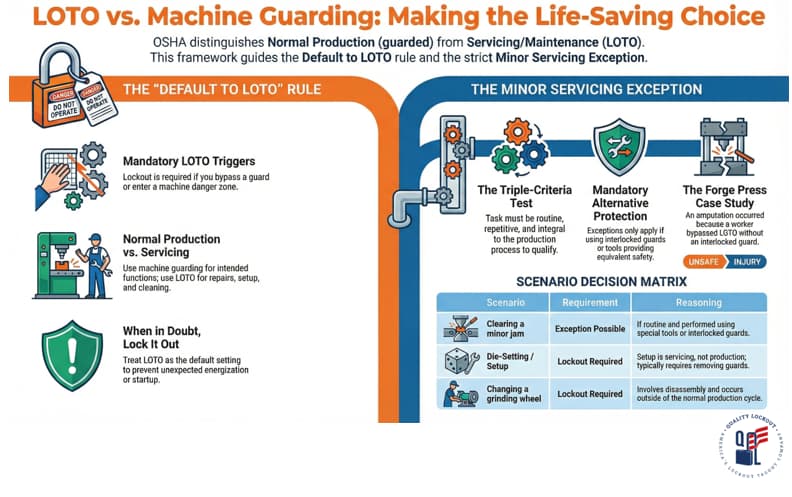
Lockout/Tagout = Servicing & Maintenance Lockout/tagout applies when workers go beyond the barrier. This includes entering inside guards, reaching into points of operation, or working near stored energy. Its purpose is to prevent unexpected startup or the release of hazardous energy. The OSHA 29 CFR 1910.147 is the LOTO standard and OSHA’s guidance within the standard explains when LOTO applies versus when machine guarding under Subpart O is the controlling requirement.
Red-Line Triggers That Require LOTO
Lockout is required whenever a task involves any of the following:
- Removing or bypassing guards or safety devices.
- Placing any part of the body into a danger zone.
- Exposure to stored energy.
- Loss of exclusive control over the energy source.
Anything short of a verified zero-energy state is unacceptable. These triggers reflect OSHA’s intent that hazardous energy must be controlled before servicing begins. What About the “Minor Servicing” Exception? OSHA allows a narrow exception for minor tool changes and adjustments during production, but the exception is limited and often misapplied. To qualify, a task must meet all three criteria:
- Routine — part of established operations.
- Repetitive — performed regularly in the production cycle (normal production operations).
- Integral — essential to making the product.
If any one of these tests fails, full lockout/tagout is required. OSHA explains these criteria and emphasizes that the exception is valid only when effective alternative protective measures are used.
Effective Alternative Protection Is Still Mandatory
Even when a task qualifies as minor servicing, workers must be protected by reliable alternative measures — preferably engineered controls rather than procedures alone. Acceptable protections include interlocked guards that shut off power when opened; special tools that prevent hands from entering danger zones; remote devices; and automated or external lubrication systems. If protection depends only on training, policies, or people “being careful,” the exception does not apply. OSHA lists similar examples of acceptable alternative measures in its guidance. Common Tasks — What the Rules Really Say
- Clearing small jams — Possibly exempt. Only if the task is routine, repetitive, and integral, and special tools prevent entry into danger zones.
- Changing grinding wheels — Yes, LOTO required. This requires disassembly and occurs outside production.
- Die setting or setup — Yes, LOTO required. Setup is not production and usually requires guard removal.
- Lubrication via remote fittings — Possibly exempt. No guard removal and no danger-zone entry.
Why “Lock It Out” Is the Smart Default
Lockout/tagout is the baseline whenever engineered safeguards are missing, incomplete, or uncertain. Shortcuts because a task will “only take a second” lead to catastrophic injuries. When uncertainty exists, choose the safest option. OSHA’s materials underscore that the minor-servicing exception is an exception — not the rule — and should be used sparingly and with documented alternative protections.
The No-Brainer Safety Check
Before starting any task, ask:
- Am I reaching into a danger zone?
- Am I bypassing or removing a guard?
- Is there a chance I do not have exclusive control?
- Is there any doubt about whether the protection is truly effective?
If the answer to any of these is yes — Lock it out.
About the Author – Jared Lowery has over 24 years of experience in the LOTO industry and is a subject matter expert at Quality Lockout, LLC. He leads development and continuous improvement of machine-specific LOTO procedures that meet OSHA 29 CFR 1910.147. Jared focuses on reducing risk, improving program accuracy, and elevating safety performance through clear documentation and field-ready procedures.
If your organization is unsure whether its LOTO procedures meet OSHA’s intent, or if you’re relying on generic documentation, now is the time to act. Quality Lockout, LLC provides machine-specific procedure development, program audits, and turnkey LOTO solutions. Connect with the Quality Lockout team at Qualitylockout.com or call 1.800.343.0829.