OSHA Fines & Abatement
When OSHA issues a citation, the financial penalty often gets the most attention. While fines can have a significant impact on a business, they are only one part of the enforcement process. For safety professionals, the real priority is understanding how to correct the hazard, document the corrective actions, and prevent similar issues from occurring in the future.
A well-executed abatement process not only helps organizations comply with OSHA requirements but also strengthens workplace safety and demonstrates a commitment to protecting employees.
Understanding OSHA Fines
OSHA citations are issued when an inspection identifies violations of workplace safety and health standards. The amount of a fine depends on several factors, including the severity of the hazard, the employer’s size, the company’s history of previous violations, and whether OSHA determines the employer acted in good faith.
Violations are generally categorized as:
- Other-than-Serious: Violations that have a direct relationship to job safety and health but are unlikely to result in serious injury or illness.
- Serious: Conditions where there is a substantial probability that death or serious physical harm could occur.
- Repeat: Violations that are substantially similar to previously cited hazards.
- Willful: Violations committed with intentional disregard for OSHA requirements or plain indifference to employee safety.
- Failure to Abate: Additional penalties that may be assessed when an employer does not correct a cited hazard by the required deadline.
While OSHA periodically adjusts penalty amounts to account for inflation, the true cost of a citation often extends far beyond the fine itself. Lost productivity, legal expenses, project delays, increased insurance costs, and damage to an organization’s reputation can quickly outweigh the initial penalty.
What Is Abatement?
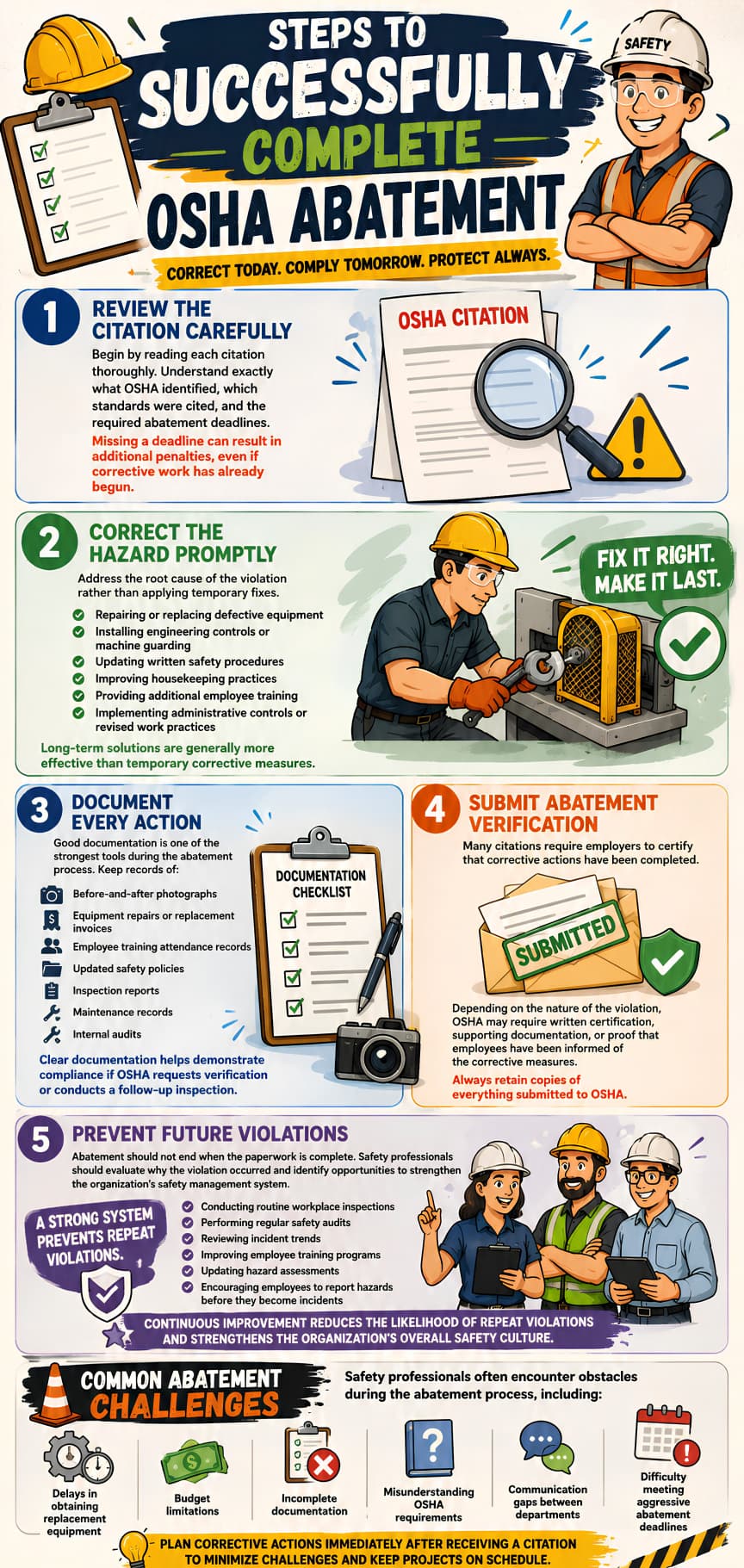
Abatement is the process of eliminating or controlling the hazardous condition identified in an OSHA citation. Every citation includes an abatement date, which establishes the deadline for correcting the violation.
Correcting the hazard is only part of the process. Employers are also responsible for demonstrating that the violation has been addressed and, when required, providing documentation that verifies the corrective actions have been completed.
OSHA may request evidence such as photographs, training records, inspection reports, purchase receipts for new equipment, engineering documentation, or updated written safety procedures.
Best Practices for Safety Professionals
Successful abatement requires more than simply fixing a problem.
Consider these best practices:
- Assign responsibility for each corrective action.
- Establish internal deadlines ahead of OSHA’s due dates.
- Track progress using an action item log.
- Verify that corrective measures remain effective over time.
- Communicate updates with leadership and affected employees.
- Maintain organized records for future inspections.
Treat every citation as an opportunity to improve workplace safety rather than simply satisfying a regulatory requirement.
Final Thoughts
OSHA fines can be costly, but the greatest value lies in correcting hazards before they lead to injuries, illnesses, or future violations. An organized, well-documented abatement process protects employees, demonstrates regulatory compliance, and helps build a stronger safety culture.
Quality Lockout supports companies throughout the abatement process by providing expert guidance, compliant lockout/tagout solutions, and clear documentation practices that align with OSHA expectations. From identifying gaps in current programs to implementing effective energy control procedures and training employees, Quality Lockout helps ensure hazards are corrected efficiently and sustainably. With the right partner, abatement becomes more than a requirement—it becomes a foundation for safer, more reliable operations.
About the Author
Katherine Doty serves as Head of Customer Support at Quality Lockout LLC, where she is dedicated to strengthening customer retention, brand loyalty, and long-term client success through exceptional technical support and service excellence. With a strong belief that safety and compliance are built on trust—not just troubleshooting—Katherine plays a critical role in ensuring clients receive reliable guidance, responsive support, and confidence in their Lockout/Tagout programs.
As a results-driven sales and customer relationship leader with more than seven years of experience in competitive markets, Katherine brings extensive expertise across the full customer lifecycle, including prospecting, relationship management, strategic partnerships, account growth, and client retention. Her background combines sales leadership with operational support, allowing her to bridge customer needs with practical solutions that drive both satisfaction and business growth.